Who’s benefiting from Massachusetts’ free AI training?
Building an inclusive tech workforce means making sure everyone has access to the skills employers want. Massachusetts' free AI training program is a big step in that direction — and this MassLive deep dive examines who's taking advantage of it, and who still needs a way in
A deep dive into the 38,000-plus signups
Published: Aug. 17, 2026, 5:37 a.m.Hadley Barndollar | HBarndollar@masslive.com
Tricia Canavan acutely feels the all-out sprint toward AI proficiency. As a provider of tech workforce development and digital literacy in Hampden County’s Gateway Cities, it’s almost impossible for her to ignore.
“We want to ensure that people don’t get left behind,” said the CEO of the Springfield-based Tech Foundry.
The nonprofit is already offering some AI-centric classes developed internally. But now there’s a new opportunity coming from the state that may serve as a “backbone” to future AI instruction at Canavan’s organization — and for an unlimited number of Bay Staters.
In February, Gov. Maura Healey announced Massachusetts would begin offering state-sponsored AI training to all residents, for free.
The partnership between the state and Google has been billed as an opportunity for anyone to learn the increasingly in-demand skills, whether they’re entering the workforce or have long left it. Those who complete the training — which typically costs $49 per month — can achieve Google’s AI Professional Certificate.
As of late June, more than 37,500 residents had signed up, as well as several hundred non-residents, bringing the total to more than 38,300.
That’s according to data MassLive obtained from the Massachusetts Technology Collaborative (MassTech), which houses the state’s $100 million AI Hub. The numbers provide a window into who is utilizing the free training and where, as the artificial intelligence explosion barrels ahead. It’s also an early indicator of whether the state’s effort is democratizing knowledge and access.
Some takeaways include:
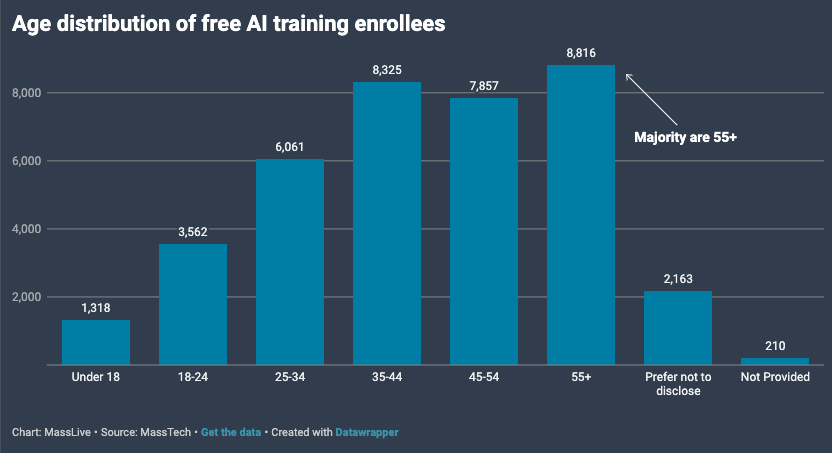
The majority of enrollees are skewing older (55+) and disproportionately highly educated, raising questions about whether the training could better target pockets of the population that stand to benefit most.
Most enrollees are employed and want to improve their current job skills.
Participation varies widely across geography — sheer volume is concentrated in Greater Boston, but some of the highest per-capita engagement is coming out of Western Mass. communities.
The state isn’t collecting race or gender data on enrollees.
The no-cost partnership with Google — which runs through December 2027 — is one way the state is trying to bring residents along as it advertises itself as a global leader in AI-powered innovation. The February announcement followed similar Google training launches in Virginia, Oklahoma and Pennsylvania.
Read more:I enrolled in the state’s free AI course to see how tough it is
Lisa Gevelber, founder of Grow with Google, said the offering ensures that “every student, employee and small business owner across the commonwealth can thrive in the AI economy.”
“Right off the bat, we had strong interest,” Sabrina Mansur, director of the Massachusetts AI Hub, said of the training. Between February and March, more than 23,700 people signed up, the peak application period thus far, the state’s data shows.
According to PwC’s 2026 Global AI Jobs Barometer, workers with AI skills earn 62% more than their peers without the skills working in the same roles. Separately, Google reports that over 70% of its career certificate graduates experience a positive career outcome within six months — such as a promotion, raise or new job.
Who is signing up? Older and educated
According to enrollment numbers from MassTech through late June, the largest share of participants reported being ages 55 and over (23%), followed by the 35-44 range at 21.7%.
More than 54% described themselves as professionals looking to upskill. More than 59% said they were employed.
More than 45% said their goals for enrollment included improving their current job skills, while nearly 30% said they wanted to “get a job.”
Some people are taking the courses to gain a basic understanding of AI. Others are enrolling in higher-level courses focused on niche topics such as app development, “vibe coding” and cybersecurity.
Read more:Mass. startups grapple with soaring AI costs and runaway spending
Johannes Romatka, manager of curriculum and instruction at Tech Foundry, completed the free offering several months ago. As someone who is “fairly competent when it comes to AI,” he was interested in learning more about Google’s approach as a major player in the space with its Gemini products.
“It is so important to supply the right information and context,” Romatka said, and he thinks Google does.
Of particular note for him was the inclusion of “responsible AI” principles in the training.
“I personally, had that not been there, I think I would have found it difficult to make a recommendation,” Romatka said. “One of the things I worry about … I saw someone online use the term ‘intellectual surrender.’ If someone is letting AI guide every aspect of their life without introspection and critical thinking, that is something that is dangerous."
Despite considering himself well-versed in the technology, Romatka said he walked away with some new knowledge about prompt engineering that he’s excited to apply.
His experience also highlights a notable aspect of who is taking advantage of the program.
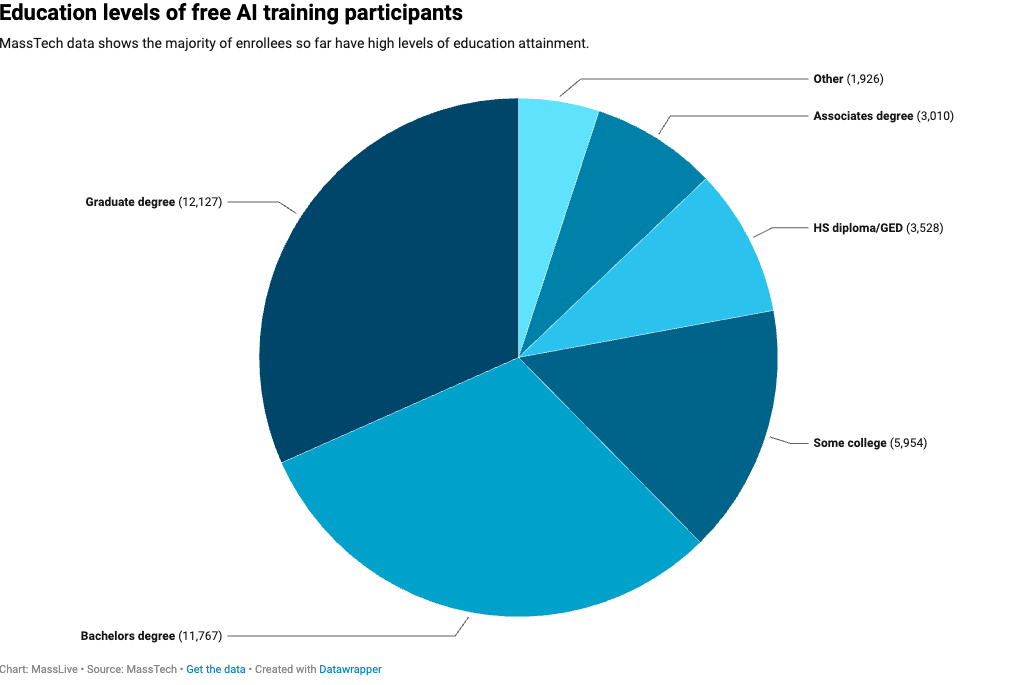
The enrollment data provided by MassTech contrasts starkly with statewide education attainment statistics: the largest percentage of participants (nearly 32%) reported having achieved a graduate degree.
According to U.S. Census data, 23% of Massachusetts residents have a post-grad degree. A majority of residents have not finished college.
The data point shows that a large share of people accessing the state’s free AI training have higher levels of educational attainment than most Massachusetts residents.
Enrollees with an associate’s degree (8%), a high school diploma/GED (9%) or “no formal education” (4%) represented the smallest share of those signing up.
Mansur said the AI Hub plans to evaluate the numbers and adjust accordingly.
“Now that we have that six-month window of data, we can start to think about more strategic targeting, where it makes sense,” she said.
Outreach efforts are continuing, Mansur added, particularly in partnership with MassHire, a statewide workforce development system.
Questions about equity
AI is advancing at a pace almost unimaginable just a few years ago, and excitement is building over the possibilities. But whether benefits of the technology will be reaped equitably is a pillar of the societal maelstrom over AI.
“Innovation in itself, while it’s exciting, we also want to make sure it’s paired with inclusion and not just helping those folks who are already positioned to benefit,”said Kathy Bisbee, director of the Alliance for Digital Equity and co-facilitator of the Mass Digital Navigators’ Alliance.
Communities affected by the existing digital divide risk being left further behind in the age of AI unless intentional efforts are made to bring them into the fold, she said. It’s no small task, especially when there is growing distrust in AI and its billionaire companies.
Read more:Worried about AI? So are many Mass. voters who want the state to step in
A public opinion survey from MassINC Polling Group, published last month, found that a strong majority of Massachusetts voters favor immediate state-level regulation to rein in the tech industry.
Missing from MassTech’s data are any indications of race or gender of participants. Up until this point, the sign-up form for the Google training hasn’t included those demographic questions. Mansur said it wasn’t a “conscious decision,” but rather they were trying to streamline the registration process and cut down on the number of questions people were required to answer.
“It’s certainly something that we could look at adding as we go,” Mansur said.
The Rev. Chris Hope, an AI ethics strategist and workforce developer, said gathering race and gender data is a critical step for the state AI Hub to better understand who is actually accessing the training.
Based on the high levels of education reflected in the statistics, Hope said it appears to be “functioning as kind of enrichment for the already-credentialed.”
“I think it’s a solvable problem,” he emphasized, advocating for the initiative to develop a “stated equity target.” Hope has done similar work at his nonprofit, The Loop Lab, a workforce initiative that connects young people with careers in audio, video and digital media.
“Something like this is meant to try to create opportunities across the spectrum of educational, socioeconomic and racial backgrounds,” he said.
Read more: Would you take spiritual advice from a chatbot? These questions are landing in a reverend’s inbox
Hope, a Cambridge minister and an internationally sought speaker on AI, hailed the free training as “a really strong, powerful first step in trying to balance the scales a little bit in terms of the public and AI.”
But “right now the early numbers suggest the program is still finding its footing as an equity strategy,” he said.
Geographic analysis
A MassLive analysis of zip codes provided by participants shows several geographic trends playing out:
Western Massachusetts is punching above its weight in per-capita rankings
High-income, highly educated communities, home to likely early adopters of AI, saw significant uptake
Moderate-to-low demand is seen across the state’s 26 Gateway Cities
The sheer volume of enrollment is heavily concentrated in Boston proper and the Greater Boston area — the most populous area of the state. Boston represents more than 13% of total participation, followed by Cambridge, an international biotech hub, at 3%.
Worcester and Springfield rank next, third and fourth, respectively, as the state’s second- and third-largest cities.
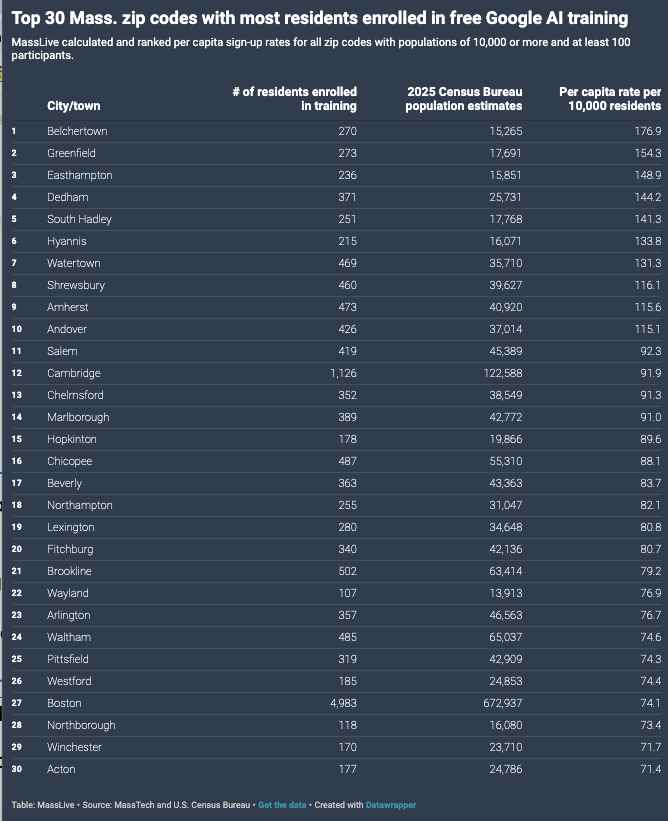
And yet, despite high raw totals, Worcester and Springfield’s per-capita participation is lower than that of most communities with 10,000 or more residents.
MassLive analyzed per-capita participation rates for all communities with 10,000 or more residents that had at least 100 enrollees. Those topping the list are Belchertown, Greenfield, Easthampton, Dedham, South Hadley, Hyannis and Watertown.
Read more:Healey releases ‘expectations’ for responsible data center development in Mass.; what are they?
The presence of Western Massachusetts communities in the top rankings is significant because the area is disproportionately affected by the “digital divide,” which refers to gaps in access to technology and the internet.
For example, when the federal Affordable Connectivity Program ended in 2024, an estimated 70,000 residents in the western part of the state were affected by the cuts.
Bisbee, of the Western Mass.-based Alliance for Digital Equity, a coalition of 200-plus members housed at Baystate Health, theorized that the region’s robust network of “digital navigators” could be behind the participation numbers. Digital navigators are trained community guides who help people gain confidence in today’s tech-centered world.
“People-to-people and people-centered trust is what really strengthens our communities,” Bisbee said. “The newest thing or whatever technology comes along, we want to make sure everyone has access to the tools they need to really have an impact on their quality of life and participation in digital life and civic life.”
And while AI is the major focus of the moment, Bisbee said, many people who need help from digital navigators don’t have working devices, or they recently canceled internet in order to afford groceries — making AI literacy a far leap.
Another Western Mass. community with a high participation rate is Amherst, home to one of the most educated populations in Massachusetts and several major higher-ed institutions. Despite being the 41st-largest community in the state, it ranks 9th for per-capita participation among communities with 10,000 or more residents.
Shrewsbury, Andover, Chelmsford and Hopkinton all rank near the top, suggesting high participation in affluent and upper-middle-class suburbs where median incomes range from $130,000 to more than $200,000 and the rate of bachelor’s degree attainment is high.
The data also shows varying demand coming from the state’s Gateway Cities. Defined as midsize urban centers where median household income and college education rates are below the state average, the state’s 26 Gateway Cities are also home to 40% of its immigrant population.
Workforce development efforts often focus heavily on the Gateway Cities.
Salem, Chicopee, Fitchburg, Pittsfield, Holyoke and Brockton have the highest per-capita participation in the AI training among the cities, indicating it may be functioning as a workforce mobility tool.
Other Gateway Cities, however, have demonstrated very low participation in the training, including Fall River, Lynn and Taunton.
Canavan, of Tech Foundry in Springfield, said many low- to moderate-income residents who could benefit from the training likely struggle to find the time to sit down and complete it.
The Google AI Professional Certificate program, for example, is an seven-module, self-paced course on the Coursera website, and it takes roughly 8-12 hours to complete. But for many, those hours can be a significant commitment.
“We notice among our students that people are under a lot of stress and there’s a lot of economic pressures, social pressures,” Canavan said. “There’s a lot going on in people’s lives, and it’s time-consuming. So this notion of, ‘I’m living my life and taking care of my family and working and to add this on top,’ it may just feel daunting to people.”
Canavan is excited about incorporating the Google training into her organization’s curriculum, though Tech Foundry’s philosophy is rooted in in-person instruction at its locations in Springfield and Holyoke.
But “asynchronous online learning is better than no learning,” Canavan said, especially when organizations like hers are staring down an already wide digital divide.
“We don’t want that gap to grow.”